

Directors – Disqualification – Whether defendant unfit to be company officer –
Length of Disqualification Period
_____________________________________________________________________________________________________________________________________________________________
IOM FSA v Megson, Civil Procedure, 9 October 2025
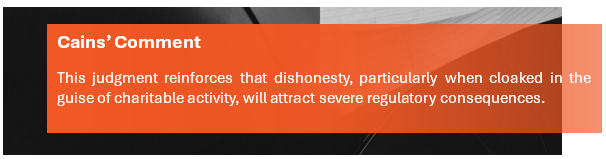
In this case, the Isle of Man Financial Services Authority successfully applied for a 12‑year disqualification order against Mrs Megson under the Company Officers (Disqualification) Act 2009 to disqualify her from acting as a director or being otherwise concerned in the management of a company. The application was undefended.
Mrs Megson was a director and officer of Manx Equitherapy Ltd, incorporated in 2012 and struck off in 2023 for failing to file its annual return. On 29 June 2023, she was convicted of thirteen offences, including falsely presenting the company as a registered charity, obtaining relief from a debt by deception, fraud by false representation, and obtaining benefits by dishonestly making a false representation. She received a 39‑month custodial sentence on 8 September 2023.
The Court can make the disqualification order if it is satisfied that Mrs Megson is an officer of a company and Mrs Megson’s conduct renders her unfit to be an officer of a company. Relying on Karen Allen v Registrar of Companies [2024] UKPC 26, the Court emphasised that unfitness is a factual assessment. Under Schedule 1 of the 2009 Act, dishonesty convictions are central. Mrs Megson’s misuse of charitable status and her pattern of deception were held to be clear evidence of unfitness and is sufficient to justify disqualification.
Period of Disqualification
Applying the summary approach in FSA v McCarthy [2019] MLR 597 and the three‑bracket framework from Re Sevenoaks Stationers (Retail) Ltd [1991] 3 All ER 578, the Court placed the case in the top bracket of particularly serious misconduct. With no mitigation offered, a 12‑year ban was imposed to protect the public and deter abuse of directorial positions with Deemster Corletti calling this “the most disgraceful use of a charitable shield to hide what amounted to a serious fraud.”
The full judgment can be found at: https://www.judgments.im/content/J3389.htm
Disclosure – Costs – Time – Proportionality
_____________________________________________________________________________________________________________________________________________________
MIR Limited and MIR UK Limited v Bader – Ordinary Procedure, 3 November 2025
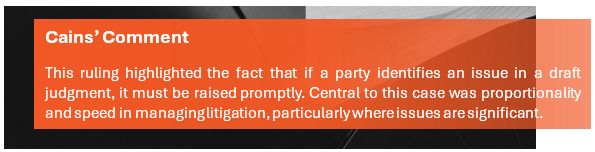
Following the Court’s earlier judgment of 29 May 2025, the parties were unable to agree the terms of a disclosure order, leading to further directions from Deemster Corlett. A central issue concerned disclosure of documents stored on Mr Bader’s mobile phone, which following voluntary disclosure, had since become inoperable.
Given the intrusive nature of accessing such data and the need for the owner’s fingerprint to reactivate the device, the court ordered that the phone‑resurrection expert must be based in Mr Bader’s country of residence, must be familiar with Isle of Man expert‑evidence law and practice, and must confirm complete independence from him. The costs of retrieving the data were to be borne in the first instance by Mr Bader as part of his disclosure obligations.
The MIR parties were allowed to amend the quantum in their Particulars of Claim, and the Defendants were permitted to amend their Defence. Although the Court made no order as to costs in relation to the Amended Particulars of Claim criticising both sides’ handling of disclosure, the court ordered that the costs of the Amended Defence will be borne by the Claimants. An allegation that Mr Bader had deleted laptop material was rejected from inclusion within the order because it had not been raised at the earlier hearing.
On the question of redacting employee names from company ledgers, the Deemster reaffirmed that in minority oppression cases “the books of the company must be open to all sides”, rejecting any attempt to limit disclosure.
The Court ordered that the materials referred to within a letter relevant to the valuation of MIR must be disclosed including material within a data room which is no longer accessible.
Finally, the court stressed that issues already determined in the 29 May 2025 judgment could not be revisited months later and issues fully argued at the hearing but not addressed in a draft judgment or any other concerns of clarification required from a draft judgment must be raised promptly to ensure proportionality and efficient use of court time.
The full judgment can be found at: https://www.judgments.im/content/J3393.htm
Permission to Appeal to the Privy Council – Out of Time – Factors Considered
___________________________________________________________________________________________________________________________________________________________________
Vernon v HMAG – Staff of Government, 12 November 2025
In this case, the Staff of Government Division considered an extremely late application for permission to appeal to the Judicial Committee of the Privy Council (JCPC). The Applicant sought to challenge a decision made 21 months earlier, despite his original appeal against sentence having been dismissed in November 2023 as meritless. The Court found that the new application contained no fresh material, describing it as largely “a regurgitation” of the submissions previously rejected.
The Applicant had been convicted by a jury in January 2023 of stealing nearly £1 million from his elderly grandfather‑in‑law. He was sentenced on 28 April 2023 to nine years’ custody. His subsequent attempts to challenge the sentence were unsuccessful.
Time Limits for Appeals to the Privy Council
Historically, Section 24 of the High Court Act 1991 imposed no express time limit for appeals to His Majesty in Council. The Isle of Man was unusual in this respect, with other jurisdictions, such as Jersey, having introduced limits long ago. To address this “obvious failing”, the Judge of Appeal Cross KC and Acting Deemsters Wild and Smith exercised their powers under Section 25 of the 1991 Act to introduce a 21‑daytime limit with effect from 1 December 2024, including transitional provisions for cases already in progress.
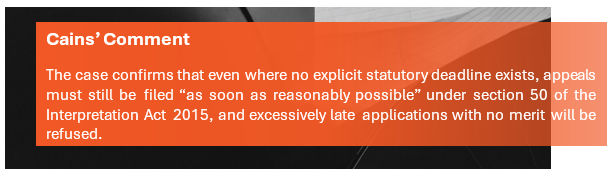
The Applicant argued that the new time limit did not apply to him because his case pre‑dated December 2024. However, he overlooked Section 50 of the Interpretation Act 2015, which provides that where no time limit is specified, a step must be taken “as soon as reasonably possible”. The Respondent relied on this provision and cited AG v Kewley (2001–03 MLR), where the Appeal Division applied the equivalent rule under the former Interpretation Act 1976.
The Court held that a time limit exists by virtue of Section 50, even before the 2024 rule change.
In deciding whether to extend time, the Court applied four established factors:
- Length of delay
- Reasons for delay
- Prospects of success
- Prejudice to the respondent
This is a non-exhaustive list and in each case several factors should be considered in the interests of justice.
The delay of 21 months was ‘inordinate’, and no satisfactory explanation was offered. The Court also rejected the Applicant’s argument that it was bound to follow sentencing guidelines from other jurisdictions, noting that no such requirement exists in statute or case law.
On the merits, the Court found:
- No arguable point of law of general public importance
- No miscarriage of justice, let alone a serious one
- No basis on which permission could properly be granted
Permission to appeal to the JCPC was refused. The Court held that the application is wholly misconceived and utterly unmeritorious. The Applicant may renew his application directly to the JCPC but must do so within 21 days of the judgment.
The full judgment can be found at: https://www.judgments.im/content/NEW%20PTA%20Judgment%20-%2012.11.25.pdf
Strike Out – Construction of Articles of Association (2006 Act) – Valid Shareholders Resolution
______________________________________________________________________________________________________________________________________________________
Evans v Wilson Trust Corporation and Others – Chancery Procedure, 10 November 2025
In this case, the Court considered whether a written resolution removing the Claimant as a director had been validly passed and whether her claim challenging that resolution should be struck out or dismissed summarily. The First Defendant argued that the Claimant lacked standing, the resolution was lawful, and the claim had no real prospect of success.
The Court relied on the well‑established principles governing strike out (RHC 7.3) and summary judgment (RHC 10.46), recently endorsed by the Privy Council in JP SPC 4 v RBS International Ltd [2022] UKPC 18; [2023] AC 461. As the facts were agreed, the issue was a pure question of law suitable for early determination in line with the overriding objective of dealing with cases expeditiously and cost‑effectively.
All six members of the company were present at the meeting.
- 45% of shares (held by five members including the Fifth Defendant personally) voted in favour of removing the Claimant.
- 55% of shares were jointly held by the Claimant and the Fifth Defendant in a representative capacity. Due to disagreement between the joint owners, these shares could not vote.
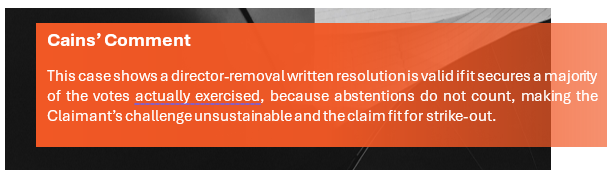
The Claimant argued that the resolution failed because only 45% of the total shareholding supported it. The Defendants argued that the correct test was a majority of votes actually exercised, not of all shares present.
The company used the Model Articles under the Companies Act 2006. The Court relied heavily on Origo Partners PLC v Brooks Macdonald Asset Management (2015 MLR Note 12), approving Deemster Doyle’s 19‑point guide to construing Articles of Association and his conclusion that abstentions do not count (para [103]).
Applying Article 14.17 – requiring approval by shareholders holding more than 50% of the voting rights exercised – the Court held:
- The majority shareholder did not vote.
- Only the 45% who voted in favour were relevant.
- As abstentions are excluded, 45% constituted a majority of the votes exercised.
The resolution was therefore passed, and the Claimant ceased to be a director on that date.
The Court found “absolute merit” in the First Defendant’s argument that the Claimant had no standing and that her claim was bound to fail as a matter of law. The claim was struck out in its entirety. Although the Court considered marking the claim as “totally without merit” under RHC 7.6(6)(a), it declined to do so.
The full judgment can be found at: https://www.judgments.im/content/Judgment%2010%2011%2025.pdf
Strike Out – Limitation – Procedural Irregularity
__________________________________________________________________________________________________________________________________________________
Skellorn v A&A Property Management Limited – Staff of Government Division, 17 November 2025
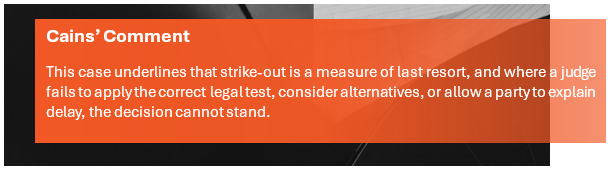
In this case the Staff of Government Division considered an appeal against the strike‑out of the personal‑injury element of the Appellant’s Particulars of Claim. The Appellant, leaseholder of an apartment since 2007, alleged that the Respondent – freehold owner from 2016 – had breached covenants in the lease and statutory duties under the Housing (Standards) Regulations 2017, seeking specific performance, damages for breach, and general damages for pain, suffering and loss of amenity.
The personal injury claim had been issued in May 2020 but remained dormant for nearly five years. At a directions hearing on 8 May 2025, the Appellant sought to amend her pleadings. Acting Deemster Melton refused, stating it was “far too late” to reinstate the personal injury claim and disallowed it for inactivity. However, he did not refer to the relevant procedural rules – RHC 6.13 (pleading requirements) or RHC 7.3 (strike‑out) – nor to the Court’s inherent jurisdiction.
The Appellant appealed, arguing that the Deemster misunderstood the reasons for delay, acted unfairly, and failed to apply the correct legal test. The Respondent maintained that the decision was a proper case‑management ruling and that the personal injury pleading lacked the detail required by Rule 6.13.
Legal Principles
The Court emphasised that a Deemster must identify which jurisdiction is being exercised and apply the correct legal test. Strike‑out is a draconian remedy, and alternatives must be considered. The Court referred to Megson v King William’s College (2DS 2012/24), which approved the modern approach to strike‑out under Rule 7.3 and limited reliance on inherent jurisdiction.
The Court also held that the Deemster’s failure to allow the Appellant to provide evidence explaining the delay amounted to a procedural irregularity, even though this did not automatically render the decision wrong.
The appeal was allowed. The Court found:
- There was no material justifying the extreme step of strike‑out.
- The Deemster should have considered less drastic alternatives.
- The personal injury claim should not have been dismissed solely for inactivity without proper inquiry.
The Court ordered that medical reports be served as soon as possible, and that written submissions on costs be filed within 21 days.
Additional Observation
The Court noted that the 2009 High Court Rules are outdated and should be modernised in line with Part 16 of the CPR, recommending review by the High Court Rules Working Group.
The full judgment can be found at: https://www.judgments.im/content/J3403.htm
Strike Out – Defective Particulars of Claim – Limitation
__________________________________________________________________________________________________________________________________________________
Wozniak v Thompson – Civil Division, Ordinary Procedure, 21 November 2025
This case concerned an application to strike out the Claimant’s Particulars of Claim (PoC) in a serious personal‑injury action arising from a road traffic accident which occurred on 9 January 2022. The Claimant’s Advocate filed a HC1 Claim Form on 8 January 2025, one day before the expiry of the three‑year limitation period, indicating that the PoC were “to follow”. On 7 May 2025, nearly four months later (and just within the permitted period), the HC1 and PoC were served together on the Defendant by Coroner. An English barrister prepared the PoC on behalf of the Claimant, however it was filed and served undated, unsigned and without a proper statement of truth or address for service.
The Defendant applied to strike out the PoC as fundamentally defective, relying on RHC 6.7, 6.8, 7.3, 8.68 and 8.69(1). It was argued that the defects could not be cured because the limitation period for bringing the claim had expired. The Claimant contended that the claim was not defective as the HC1 and PoC, served simultaneously on the Defendant, should be treated as one composite document, meaning the HC1’s statement of truth and address for service referred to the PoC enclosed and therefore satisfied the rules.
The Court rejected the Claimant’s argument, holding that the HC1 and PoC could not be treated as a single statement of case if served together, even allowing for ambiguity in Rule 6.9(3). While Rule 6.12(1)(d)(ii) only requires an address for service when PoC are served separately, the absence of a signed statement of truth was a clear breach of Rule 8.68(1)(a). This gave the Court discretion to strike out the PoC under Rule 6.8(3).
However, the Court also held:
- Under Rule 6.8(2)(a)), the PoC remained effective unless struck out.
- A late amendment to verify a PoC so as to include a statement of truth and signature would not breach the limitation period, as it introduced no new cause of action.
- Rule 2.59 required the Court to consider all the circumstances.
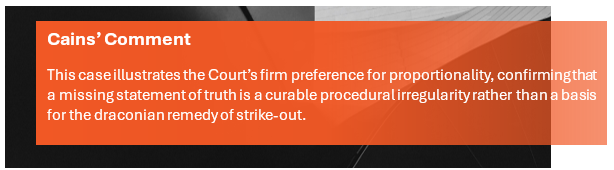
The Claimant maintained that even if the Court determined that the PoC was defective, a strike out of the claim would be “wholly disproportionate” as any breach of the rules was only “minor”.
Applying the three‑stage Denton test from Denton v TH White Ltd [2014] EWCA Civ 906, adopted in the Isle of Man in Montpelier Tax Planning (IoM) Ltd v Jones (No 2) 2015 MLR N8, the Court found:
- The breach was neither serious nor significant.
- There was no real prejudice to the Defendant.
- The breach does not significantly affect the progress of the case.
Deemster Needham described the omission as an irregularity, not a nullity.
Strike‑out of the claim was refused as such would be disproportionate and contrary to the interests of justice. The Court held that a more appropriate application would have been under Rule 8.71(2), allowing the Court to order verification of the PoC.
The Court therefore ordered the Claimant (or his advocate) to file and serve a signed and dated statement of truth verifying the PoC within 14 days. An unless order was considered unnecessary as this stage. Costs were left open, with each party permitted to apply within the usual time limits. The Deemster gave the parties a provisional view of no order as to costs due to the fault on both sides.
The full judgment can be found at: https://www.judgments.im/content/J3406.htm
Please note that this note does not constitute legal advice but is provided as non-reliance guidance only. For more information on Isle of Man Litigation Law, please contact: Robert Colquitt , Tara Cubbon-Wood or Leanne Hinds.
Reference
i The term used to refer to judges in the Isle of Man judiciary.
A copy of Cains’ Judgment Journal can be downloaded here: Monthly IOM Judgments – October and November 2025 (PDF)
