

Directors’ Duties – Misrepresentation – Fraud
Humbles, Riddell and Wiltcher v Wickers, Lavin and Tinsley, Staff of Government Division, 1 June 2026
__________________________________________________________________________________________
This judgment is long and complex, covering 57 pages and 26 grounds of appeal.
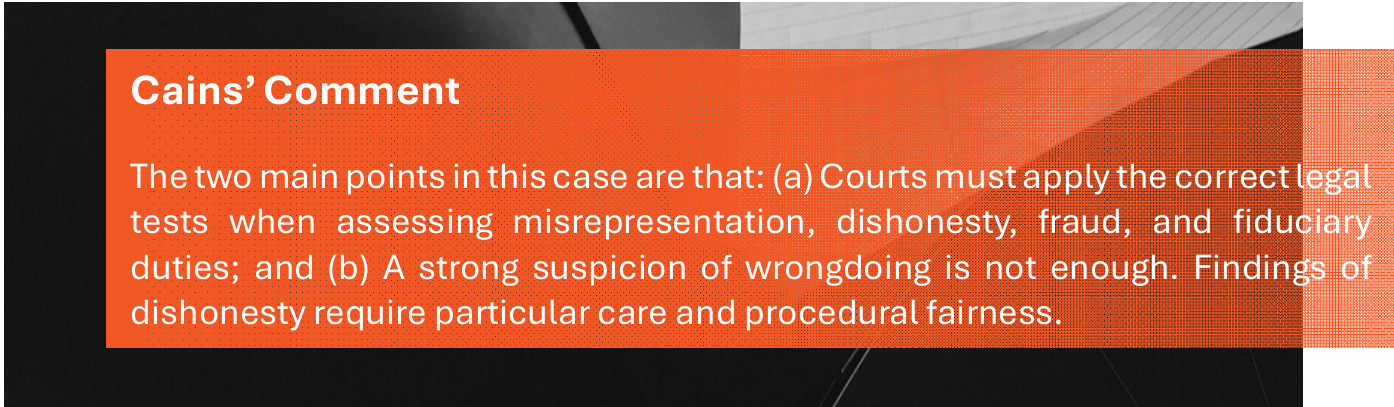
This appeal arose from a failed London property development that was expected to generate substantial profits but instead suffered losses of around £43 million, as a result of cost overruns and the 2008 financial crisis. Investors in the project sued the directors of the Manx holding company, alleging that an investment brochure had fraudulently failed to disclose a significant “success fee” paid to an associated company. At first instance, Deemster Gough1 found in favour of the investors, stating that the brochure was fraudulent, that the directors had been dishonest, and that both personal claims for misrepresentation and assigned company claims succeeded.
The Staff of Government Division overturned that decision in its entirety. The appeal Court was critical of the first-instance judgment, noting that it often set out conclusions without explaining the legal reasoning. The Court held that the Deemster had misunderstood key aspects of the transaction and had applied incorrect legal tests on several issues.
On the personal misrepresentation claims, the Court found that the directors’ statement in the brochure was not an actionable representation on which investors were entitled to rely. The Court concluded that the success fee was a legitimate acquisition-related fee rather than a disguised profit distribution, meaning that statements in the brochure about purchase costs and profit participation were substantially true. The Court also rejected the findings of dishonesty, holding that they were procedurally unfair and “rationally insupportable”. The directors denied dishonesty when challenged in evidence, they had relied on professional legal and accounting advice in preparing the brochure, and the trial judge had failed adequately to explain why that evidence was rejected. Furthermore, there was no proper finding that the investors had read and relied upon the directors’ statement when deciding to invest.
The Court also rejected several additional legal findings made. Importantly, it held that there is no recognised general “duty of candour” requiring directors to disclose all matters that might be material to investors.
The assigned claims, brought on behalf of the companies in liquidation, were also rejected. The central allegation was that the success fee constituted an unlawful distribution and a fraudulent breach of fiduciary duty by the directors. The appeal Court found that the Deemster had overlooked important contractual, accounting and expert evidence demonstrating that the payment was a genuine commercial fee for acquisition and development services. Expert evidence showed the fee was within a normal market range, it had been invoiced and paid as a service subject to VAT, and it had been approved as part of the project financing. Accordingly, the finding that the payment was an unlawful distribution could not stand.
The Court also rejected the finding of fraudulent breach of fiduciary duty. The proper question was whether the directors knew their actions were contrary to the company’s interests or were recklessly indifferent. The Deemster had not properly addressed those questions and had failed to engage with the directors’ evidence. As a result, the finding of fraud was unsustainable. The Court further held that, even if ordinary fiduciary duty claims existed, they were time-barred because the relevant facts were known to the companies and their directors many years before proceedings were commenced.
Finally, the Court allowed the remaining grounds of appeal relating to sales commissions, dressing-cost commissions and alleged misrepresentations in later correspondence, finding that the relevant factual and legal conclusions could not be supported.
In short: the Staff of Government Division concluded that the trial judge had made factual and legal errors, misunderstood critical aspects of the transaction, applied incorrect legal tests, and reached findings that could not be sustained on the evidence. As a result, all personal and assigned claims failed and the appeal was allowed in full, with the judgment against the directors being entirely set aside.
The full judgment can be found at: https://www.judgments.im/content/Humbles%20Judgment%20delivered%2001.06.26.pdf
Standing – Liquidators Conduct – Relationship between Receiver and Liquidators

Isle of Man Financial Services Authority v Montpelier (Trust and Corporate) Services Limited, Civil Division – Chancery Procedure, 23 June 2026
_____________________________________________________________________________________
In this case, Deemster Corlett dismissed an application by Edward Gittins (“Mr Gittins”) under s.189(1) of the Companies Act 1931, who complained about the conduct of the joint liquidators of Montpelier (Trust and Corporate) Services Limited (“MTCSL”). The Court ultimately held that Mr Gittins lacked standing and that none of his complaints had merit.
Standing
The Court applied the case of Deloitte & Touche AG v Johnson [1999] 1 WLR, together with Broadsheet v Moussavi (9 April 2026), confirming that standing for insolvency proceedings are determined by whether an application has a genuine economic interest in the liquidation, and consistent with Brake v Cheddington Court Estate Ltd [2023] 1 WLR 3035 and Edengate Homes Ltd [2022] BCC 940, that standing is determined by whether the applicant has a real financial interest in the outcome.
Mr Gittins claimed to have standing as he was a creditor of MTCSL and submitted a proof of debt in the sum of £1.1m due to him under a subordinated loan agreement dated 1 January 2011. It was held, however, that he was in fact a substantial debtor of the company, and as he had no economic interest as a creditor, he lacked standing to challenge the liquidators’ conduct.
The complaints
Mr Gittins made several complaints that the liquidators had breached their duties, by failing to maintain the value of Emmetview Properties Overseas Limited (“Emmetview”), by failing to ‘monitor and control’ the conduct of the receiver and manager on behalf of the company, to not prevent the strike off of Emmetview, by failing in their duty to control, monitor, secure and realise the assets of Emmetview and by their delay in seeking directions from the Court in relation to Emmetview.
Another was that there was a conflict of interest concerning the liquidation which had not been considered by the liquidators. This was held to be an ‘assertion lacking any substance’.
It was ultimately held that there were no merits in any of Mr Gittins’ complaints, and the application was dismissed.
A separate application seeking disclosure of creditors’ proofs of debt and the liquidation funding agreement was also dismissed. The Court ruled that this type of disclosure would not usually be ordered and that, in any event, the request could not succeed because Mr Gittins lacked standing.
The application was therefore dismissed in full.
The full judgment can be found here: https://www.judgments.im/content/Judgment%20delivered%2023.06.26.pdf
Contempt of Court – Partition Act 1931 – Possession

Iveagh and Iveagh v Iveagh, Civil Division – Chancery Procedure, 25 June 2026
________________________________________________________________________________
In this case, Deemster Needham, in proceedings brought under section 5 of the Partition Act 1931, ordered a co-owner to vacate the family property after finding that he had repeatedly obstructed the agreed sale of the property.
The three parties, who were brothers, each owned a one-third share in the property as tenants in common. Following the death of their mother, who had lived there with the defendant, the claimants sought a sale. Although the parties had entered into consent orders in 2025 requiring the property to be valued, marketed and sold, little progress was made, leading to repeated enforcement applications.
The Court found that the defendant had actively resisted the marketing and sale process by failing to provide proper access and comply with earlier orders. Evidence also raised concerns about the property’s condition, unpaid outgoings, possible occupancy by third parties, and uncertainty regarding insurance and security, all of which risked diminishing the property’s value.
The Deemster ruled that vacant possession was necessary to achieve an open-market sale and ordered the defendant and any other occupiers to leave within eight weeks. The Coroner was authorised to enforce the order thereafter, including by the use of force if necessary.
Importantly, the Court confirmed that the possession order did not affect the defendant’s beneficial one-third ownership. He would remain entitled to a share of the net sale proceeds, subject to deductions for outstanding liabilities and costs orders. The decision illustrates the Court’s willingness to grant possession and enforcement relief where a co-owner frustrates the sale of jointly owned property.
The full judgment can be found here: https://www.judgments.im/content/CHP24_109-250626.pdf
Permission to Appeal – Abusive Conduct by Litigant – Extended Civil Restraint Order

Wilmot and Wilmot v Lloyds International and Cains Advocates2, Staff of Government Division, 26 June 2026
____________________________________________________________________________________
In this decision, Judge of Appeal Cross KC refused permission to appeal against a default judgment (16 January 2025), a case management order (31 July 2025) and a possession order (7 November 2025), ruling that the applications were both out of time and entirely without merit.
The Court had received a large volume of handwritten correspondence over several months containing a series of unfounded allegations against lawyers, Court officials, Freemasons and others. The eventual appeal notice sought, among other things, the dismissal of the Coroner, the setting aside of all previous orders, the return of property and permission for the applicants to reoccupy the property. The Judge of Appeal observed that the grounds of appeal were difficult to understand and lacked any coherent legal basis.
Applying Rule 14.3C of the Rules of the High Court of Justice 2009 (“the Rules”) and the principles in Flexton v Breeze (No. 2) 2014 MLR 1, the Court stated that none of the applications had been brought within the required time limits. The purported appeal documents lodged in December did not constitute a valid notice of appeal and the formal appeal notice (Form HC11) was filed more than four months late, with no good explanation for the delay. The Court found that the applicants could and should have acted sooner.
The substance of the proposed appeal was also rejected. Arguments concerning alleged procedural unfairness, failures to engage with settlement proposals, non-compliance with pre-action requirements and supposed conflicts of interest were all dismissed. The Court accepted that the possession proceedings had been properly served and noted that, as previously argued by the respondent’s advocates, there are no mandatory pre-action protocols in the Isle of Man.
The Court also held that claims of “new evidence” consisted only of unsubstantiated allegations of conspiracy and misconduct, which the Court described as being “wholly devoid of merit”. The suggestion that the trial judge was under a duty to ensure legal representation for the applicants was likewise rejected. Indeed, the Court considered the conduct of the Acting Deemster at first instance to be “exemplary and beyond reproach”.
Permission to appeal was therefore refused and it was held that the applicants were not entitled to request an oral reconsideration of the refusal.
The Court then considered whether a restraint order was appropriate under Rules 2.4(7) and 2.56. Particular weight was given to Mr Wilmot’s history of abusive litigation conduct, including his conviction in England in 2025 for two counts of fraud and one count of forgery, his repeated failures to attend Court, and his use of forged court documents in earlier proceedings. The judgment also referred to persistent harassment of solicitors, Court staff, the Coroner and advocates involved in the Isle of Man proceedings.
Finding that the applicants had “individually and collectively demonstrated persistent abusive behaviour” and had repeatedly misused court processes, the Judge of Appeal imposed an Extended Civil Restraint Order for two years. Any future applications falling within Rule 2.56(a), (b) or (c) must be made directly to a Judge of Appeal.
The full judgment can be found here: https://www.judgments.im/content/Wilmot%20PTA%20Judgment%20delivered%2026.06.26.pdf
________________________________________________________________________________________________
A copy of the Cains’ Judgment Journal June 2026 can be downloaded here: Cains’ Judgment Journal – June 2026 (PDF)
Please note that this note does not constitute legal advice but is provided as non-reliance guidance only. For more information on Isle of Man Litigation Law, please contact: Robert Colquitt, Tara Cubbon-Wood or Caren Pegg.
References
1 The term used to refer to judges in the Isle of Man judiciary.
2 Represented by Jorden Rafferty-Gough, Cains
