

Limitation – Extension of Time – Strike Out – Abuse of Process
_______________________________________________________________________________
Kirk v Chief Constable of the Isle of Man and HMAG – Civil Division, Ordinary Procedure, 4 December 2025
________________________________________________________________________________
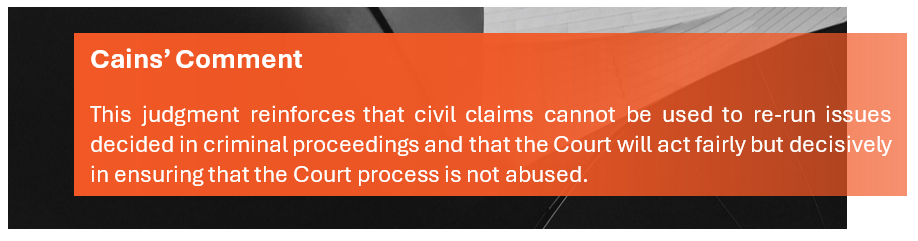
In this case, the Court struck out most of a civil claim finding that many of the allegations were out of time or amounted to an improper attempt to re‑litigate decided issues.
The Claimant was arrested on 25 March 2021 for allegedly organising a gathering on Laxey beach in breach of Covid regulations. He was acquitted at trial by the High Bailiff on 31 March 2022 and was later awarded his criminal costs. Despite this, civil proceedings were not issued until 26 March 2024.
By the time of the strike‑out hearing, the Claimant’s amended claim ran to 27 separate causes of action, seeking £3 million in damages (down from an original £33 million). The Defendants applied for strike‑out under Rule 7.3 of the Rules of the High Court of Justice 2009 (“the Rules”) and summary judgment under Rule 10.46.
A key issue was whether many of the claims were an abuse of process. The Court accepted the Defendants’ argument that several matters had already been aired and resolved in the criminal proceedings. In doing so, it followed Deemster Corlett’s1 judgment in Griffin v Chief Constable of the Isle of Man (judgment dated 21 February 2024), which applied the House of Lords decision in Hunter v Chief Constable of the West Midlands Police [1982] AC 529. As stated in Hunter:
“…the Court ought to be slow to strike out a statement of claim or defence, and to dismiss an action as frivolous and vexatious, yet it ought to do so when, as here, it can be shown that the identical question sought to be raised has already been decided by a competent Court.”
The Deemster, on the issue of abuse of process, endorsed the “broad merits-based approach” as discussed in McLoughlin v Chief Constable of Kent Police [2024] EWHC 990 (KB) stating that this approach is to be adopted in relation to abuse of process.
Claims brought under the Human Rights Act 2001 were struck out as they were brought outside the limitation period. A human rights claim must generally be commenced within one year of the date on which the act complained took place, but this period may be extended where the Court deems it equitable having regard to all the circumstances. The Deemster (applying Adenaike v DHA 2018 MLR 155) found no good reason to extend this period. A defamation claim based on a police media release from March 2021 was also struck out as out of time under the Limitation Act 1984.
In total, 22 claims were struck out or dismissed. Five claims survived, including a harassment claim and allegations of data protection breaches and assault.
The Claimant was ordered to pay 90% of the Defendants’ costs.
The full judgment can be found at: https://www.judgments.im/content/ORD24_015-04%20Dec%2025.pdf
Judgment Execution – Set Aside – Enforcement – Forcible Coroner’s Arrest
_________________________________________________________________________________
Lloyds Bank Corporate Markets Plc2 v Wilmot and Wilmot – Civil Division, Ordinary Procedure, 12 December 2025
__________________________________________________________________________________
This judgment concerned three linked applications heard together: an attempt to set aside a default judgment, a further application to dismiss that judgment, and an application to enforce it.
The dispute arose from a loan agreement entered into on 10 February 2023, secured by a charge dated 17 February 2023 over the Defendants’ property. The loan expired on 31 March 2025. No interest had been paid since May 2023 and no capital repayments were ever made.
The lender issued debt recovery proceedings in September 2024 and obtained judgment in default, with execution, in January 2025 for around £623,000.
Following this, the Defendants applied to set aside the judgment, claiming they had not been served and alleging harassment, fraud and perjury, accusing the Coroner and the Claimant’s Advocates of making false statements and misleading the Court. Acting Deemster Wild found there was “no cogent evidence to support such assertions.”
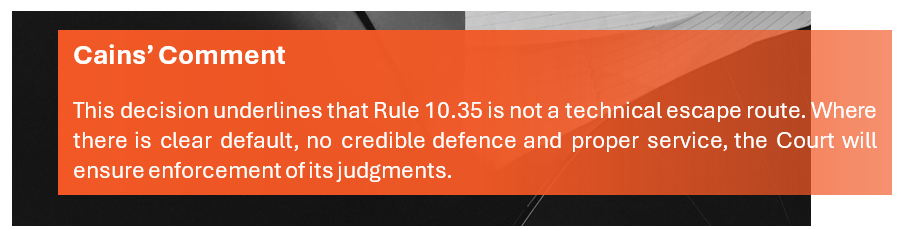
Applying Rule 10.35 of the Rules, the Court held that the Defendants had no real prospect of successfully defending the claim and no other good reason to set aside the judgment. Evidence showed the judgment had been served multiple times by email, with receipt acknowledged. Claims that the lender had failed to engage were also disproved, and the Defendants’ alleged ability to repay from other sources was irrelevant given the unpaid judgment sum.
It was suggested by the Applicants that the Court, in considering a set aside application under Rule 10.35, should exercise its discretion as if it were any application for relief from sanctions, citing in particular Denton v TH White Ltd [2014] EWCA Civ 906. Acting Deemster Wild was not convinced this was necessary in order to exercise the Court’s discretion, emphasising that Rule 10.35 could be applied on its own terms without importing tests from other rules. He added that even if a Denton-style approach were used, the application would still fail.
The Court discussed and approved Foxdale Properties v Booth (2010) when considering enforcement.
The set‑aside and dismissal applications were both dismissed. The enforcement application was granted, with an order allowing the coroner to enter the property forcibly if the debt is not paid by 27 February 2026.
Although the Court considered the Defendants’ conduct came close to justifying indemnity costs, costs were ultimately awarded against them on the standard basis.
The full judgment can be found at: https://www.judgments.im/content/Judgment%20(FINAL)%2012.12.25.pdf
Strike Out/Summery Judgment – Inordinate Delay – Res Ipsa Loquitur – Admissibility of Opinion Evidence
_______________________________________________________________________________
A v Department of Health and Social Care, Civil Division, Summary Procedure, 15 December 2025
______________________________________________________________________________
In this case, the Court refused to strike out a long‑running negligence claim brought by a disabled man via his litigation friend (his mother) finding that the issues should be determined at trial rather than dismissed at an early stage.
The Claimant, who has cerebral palsy and significant learning difficulties and is largely non‑verbal, brought the claim through his mother. He became acutely distressed after spending three days in residential respite care at a DHSC facility in June 2013 and was later diagnosed with PTSD.
A claim form was issued in 2016, with its particulars alleging negligence and failures in the treatment of the Claimant’s PTSD. A DHSC‑commissioned expert report from January 2015, later disclosed to the Claimant’s parents, concluded that verbal abuse, and possibly physical abuse, had occurred during the respite placement.
The Defendant applied for strike‑out under Rule 7.3 and summary judgment under Rule 10.46, arguing that the passage of time made the claim speculative and that a fair trial was no longer possible.
Applying the principles set out in JP SPC 4 v Royal Bank of Scotland International Ltd [2022] UKPC 18, Bexon v Lloyd Davies 2016 MLR 291 and Megson v King William’s College 2012 MLR N-20, the Court held that there remained a prima facie valid cause of action in negligence or breach of duty, which did not appear fanciful, and therefore summary judgment could not be awarded against the claim. Although the Claimant could not describe what had happened to him, the expert material indicated that the standard of care may have fallen below what was reasonable, leaving liability as a live issue for trial.
The Court also applied Rogers v Hoyle [2013] EWHC 1409 (QB), holding that investigators’ opinions on liability were not admissible simply because of their role. The Claimant would need to plead the underlying factual allegations rather than rely on the conclusions of investigation reports.
In considering whether negligence could be inferred without direct evidence (res ipsa loquitor), the Deemster referred to the summary of modern principles in O’Connor v Pennine Acute Hospitals NHS Trust [2015] EWCA Civ 1244, emphasising that Courts may draw reasonable inferences from the evidence, but that liability is not presumed.
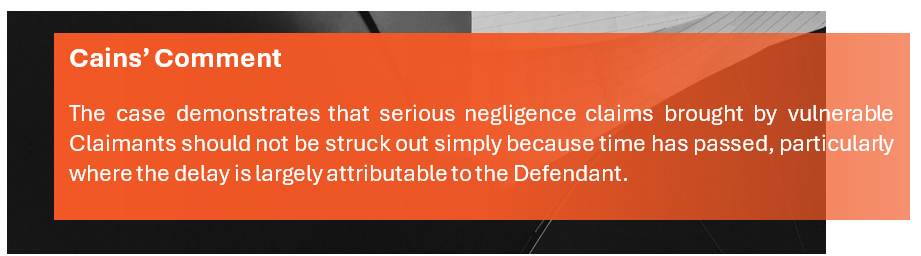
While the delay of over a decade since the events was recognised as problematic, the Court found that much of the difficulty was caused by the Defendant’s own failure to investigate promptly. The Claimant’s disability also meant that the usual limitation period did not apply (see section 26(1) of the Limitation Act 1984). Balancing the interests of justice, the Court held that it would be wrong for the Defendant to benefit from a strike‑out caused largely by its own actions.
Outcome
The applications for strike‑out and summary judgment were dismissed. The Court ordered the Claimant to file further amended particulars of claim, with the Defendant to respond thereafter. Costs were left open, with the judge indicating that they may ultimately be reserved.
The full judgment can be found here: https://www.judgments.im/content/Anonymised%20%20Judgment%2015.12.25.pdf
Costs – Execution – Interest
______________________________________________________________________________

Moussavi v VR Global Partners, LP and Broadsheet LLC (in liquidation) (acting by its liquidator Gordon Wilson), Staff of Government Division, 17 December 2025
__________________________________________________________________________________
This judgment of the Appeal Division (the Island’s highest domestic court of appeal – see Cains’ Briefing Note – Appeals and Permission to Appeal in the Isle of Man – Cains) dealt with applications to enforce two separate costs orders following earlier proceedings, and whether the Court could award interest above the statutory rate.
VR Global Partners (VRGP) applied in August 2025 to enforce a costs order of £18,000, seeking interest at 8%. A draft judgment addressing that application was circulated to all parties in October 2025 for comment, with clear directions that it was not an opportunity to re‑argue the case.
No corrections were suggested by VRGP. Broadsheet’s advocates confirmed they had no amendments but reminded the Court that Broadsheet had also applied to enforce its own costs order, worth around £29,000.
One party, Mr Moussavi, responded with complaints and objections rather than comments on the draft judgment. The Judge of Appeal allowed him further time to respond specifically to Broadsheet’s application for execution.
VRGP argued that the Court should award interest at 8% because the statutory rate of 4% under section 9(7)(a) of the Administration of Justice Act 1981 (linked to the Bank of England base rate) did not reflect commercial reality. It relied on section 9(4) of the Act as giving the Court discretion.
The Court rejected this argument, stating that section 9(4) does not give discretion to increase the interest rate and that no other rule or power had been identified which would allow a higher rate to be awarded.
As for Broadsheet’s application, the Court found there was no basis to refuse enforcement. Mr Moussavi’s objections did not address the merits of the application and did not prevent the Court from enforcing an existing costs order.
Outcome
Execution was ordered in favour of VRGP for £18,000, with interest at the statutory rate of 4% running from 27 August 2025. Execution was also ordered in favour of Broadsheet for £28,880, again with interest at 4% from the same date.
The resolution was therefore passed, and the Claimant ceased to be a director on that date.
The full judgment can be found at: https://www.judgments.im/content/Costs%20Judgment%2017.12.25.pdf
Overturning findings of fact
______________________________________________________________________________
X v Y, Staff of Government Division, 23 December 2025
_________________________________________________________________________________
This judgment is from an appeal in a family law case in which there was dispute over how and when a minor injury to a child had occurred.
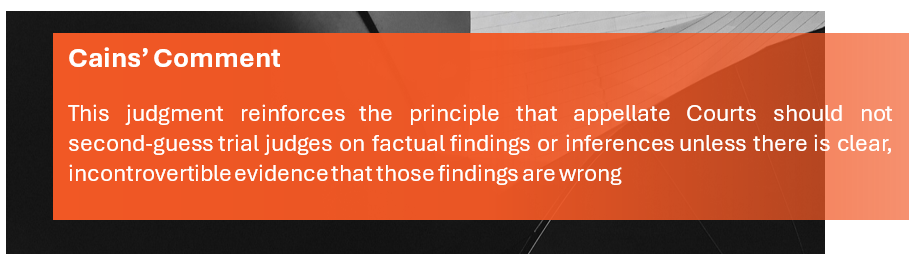
The Judge of Appeal held that the Court was not entitled to disagree with findings of fact by the original trial judge “unless there is incontrovertible material which shows that the findings of fact are unjustified. It is for the judge who hears the evidence who is best placed to weigh that evidence. Where judges in the lower Court draw inferences of fact from primary facts, then this Court cannot interfere and substitute its own preferred inference for that judge’s justifiable alternative inference.”
The full judgment can be found at: https://www.judgments.im/content/Anonymised%20Judgment%20(PTA)%20delivered%2023.12.25.pdf
Please note that this note does not constitute legal advice but is provided as non-reliance guidance only. For more information on Isle of Man Litigation Law, please contact: Robert Colquitt , Tara Cubbon-Wood or Benjamin McGee.
References
1 The term used to refer to judges in the Isle of Man judiciary.
2 Represented by Jorden Rafferty-Gough, Cains
The Judgment Journal can be downloaded here: IOM Judgments – December 2025
