

Inherent jurisdiction – Companies (Winding-Up Rules) 1934 – Stay of proceedings
_________________________________________________________________________________________________________
Broadsheet LLC (In Liquidation), Civil Division – Chancery Procedure, 9 April
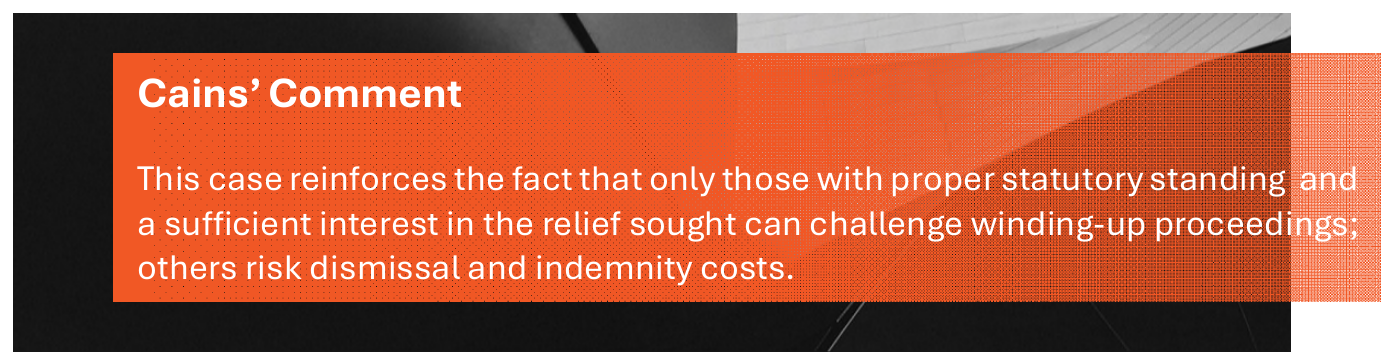
In this case Mr Moussavi issued an application dated 22 October 2025 (issued 16 January 2026) challenging the fairness of the Isle of Man High Court under Article 6 ECHR (right to a fair trial) and seeking various orders in ongoing winding‑up proceedings of Broadsheet LLC (in liquidation). Although properly notified of the hearing fixed for 9 April 2026, Mr Moussavi did not attend, and he alleged that the hearing was secret as it was not listed on the courts.im website.
The key points, set by Deemster Corlett1, included:
- No adjournment: The Court refused to delay the case to allow Mr Moussavi to appear pursuant to Rule 7.13 of the Rules of the High Court 2009 (“the Rules”), finding Mr Moussavi had disengaged from the process and that his arguments had no merit.
- No standing: Under the Companies Act 1931 (the “1931 Act”) and Companies (Winding‑Up) Rules 1934 (the “Winding Up Rules”), only creditors, contributories or certain officers of the company can bring the types of applications sought by Mr Moussavi under ss.189, 194, 204 of the 1931 Act and Rule 12 of the Winding Up Rules. Mr Moussavi therefore did not qualify under statute to make the application and seek the relief sought.
- Applicable two-stage test: Applying Deloitte & Touche AG v Johnson [1999] 1 WLR 1605; [1999] UKPC 25, Mr Moussavi lacked a legitimate and sufficient economic interest in both the company and the relief sought. As, at best, an alleged ultimate beneficial owner and as a debtor and certainly not a creditor of an insolvent company, it was determined that he had no standing.
- Inherent jurisdiction: The statutory scheme displaced any wider inherent jurisdiction.
- Res judicata: His lack of standing had already been judicially decided in an earlier judgment (10 June 2024), so the issue could not be reopened.
- Unfounded allegations: His claims and allegations of impropriety against the Court and officers of the Court (including the liquidator and various advocates) were unsupported and without foundation.
The application was dismissed as totally without merit. The Court made an indemnity costs order against Mr Moussavi.
The full judgment can be found at: https://www.judgments.im/content/Judgment%20090426.pdf
Shareholder Oppression – Disclosure – Timetabling
___________________________________________________________________________________________________________
Bellamy v Hughes and Mulberry Limited, Civil Division, Ordinary Procedure, 15 April 2026
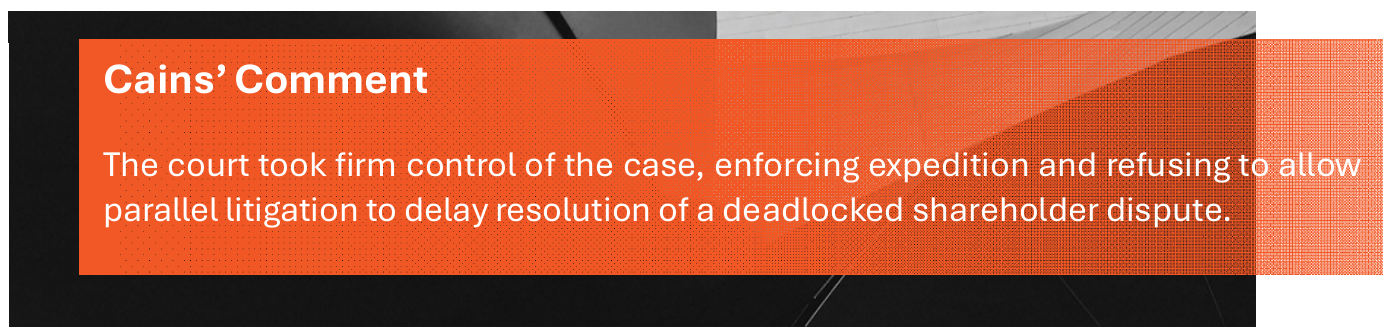
In this case Mr Bellamy and Mr Hughes, equal shareholders in a joint venture, brought competing oppression claims after their relationship broke down. The company was deadlocked and struggling to attract investment. Although both agreed the case should be expedited, they could not agree case management directions.
The dispute required expert evidence on valuation and alleged forged minutes. The matter is complicated by the parallel double derivative proceedings that had been started by Mr Hughes in England which it was said could have consequences for these proceedings. However, Deemster Corlett stated that the Isle of Man case (which relates to the holding company) would take precedence over the English litigation in relation to one of its subsidiaries and that no delay would be accepted in the Manx proceedings while those in London continued. In any case, he stated that s7 of the Companies Act 1968 provides a broad and adaptable framework for resolving shareholder disputes and a strict timetable to a trial in January 2027 was imposed.
The full judgment can be found at: https://www.judgments.im/content/Judgment%20150426.pdf
Employent and Equality Tribunal – Recusal – Rule 14.17(2) RHCJ
____________________________________________________________________________________________________________
Manx Care v Elliott and Taylor, Civil Division – Chancery Procedure, 16 April 2026
This appeal arose from decisions of the Employment and Equality Tribunal (EET) under s.127(1) Equality Act 2017, which permits appeals on points of law. The Attorney General was granted permission to intervene under Rule 14.17(2) (a rarely used provision allowing “any person” to make representations), due to concerns about criticism of advocates from the Attorney General’s Chambers in the Chair’s decisions.
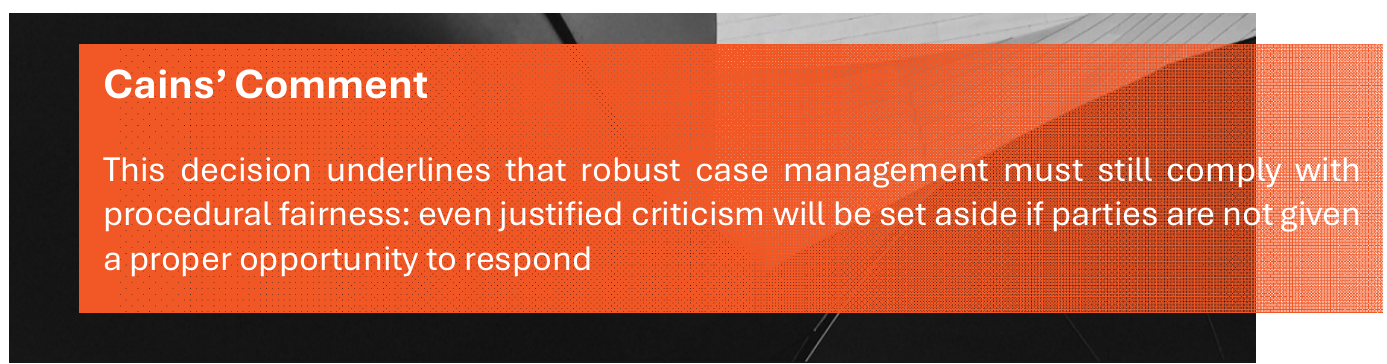
The Respondent, Manx Care, challenged parts of the Chair’s decisions, arguing procedural unfairness, as adverse findings were made without giving it an opportunity to respond; and misstatements of law regarding strike‑out and costs applications.
The key findings from the case included:
- Strike‑out applications: The Court upheld the Chair’s approach. A strike‑out is a draconian step, appropriate only in clear cases, especially in discrimination or whistleblowing claims where factual disputes should usually be tried. There was no error of law in concluding that early strike‑out threats had little or no chance of success.
- Costs applications: Under Rule 40(2) of the Employment and Equality Tribunal Rules 2018, costs orders against unsuccessful complainants are exceptional. The Court agreed that including threats of costs at the outset was inappropriate and unsustainable unless the case was plainly (“blatantly”) irregular. Manx Care’s pleadings did not meet even a lower threshold.
- Procedural fairness (Article 6): The Chair had relied on matters from other cases without giving Manx Care an opportunity to respond. Fairness required advance notice before adverse findings were made.
- Bias and recusal: Applying Moussavi v Global Partners (Appeal Division, 4 June 2025), the Court found no error in the Chair’s legal approach. However, the failure to allow responses to criticisms drawn from other cases created “a justifiable perception by the fair-minded and informed observer of a real possibility of bias”.
The appeal succeeded in part. While the Chair’s statements of law on strike‑out and costs were upheld, the Court held that procedural unfairness required intervention.
Specific paragraphs in the Review Order (3 September 2025), Order (5 September 2025) and Review Decision (22 October 2025) were set aside. The Chair was also removed from further involvement in the case (Dr Elliott v Manx Care).
The full judgment can be found at: https://www.judgments.im/content/Judgment%20160426.pdf
Company in Default of Filing Requirements – Sole Director – Enforcement Orders
_____________________________________________________________________________________________________________
DfE v AGR Motorsport Limited and Cringle, Civil Division – Chancery Procedure, 17 April 2026
In this case the Claimant applied for enforcement orders under s.285(1) of the 1931 Act and s.26(4) of the Companies Act 1992 to restore a company to good standing. The claim and hearing notice were properly served, but neither the company nor its sole director, Mr Cringle, responded or appeared.
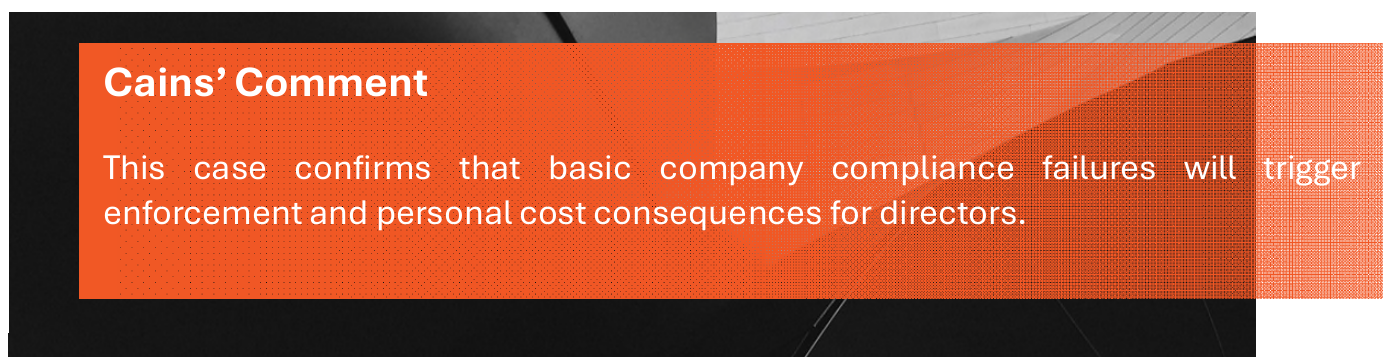
The company had failed to file annual returns since December 2020, contrary to s.109 of the 1931 Act, and had only one director since November 2024, breaching s.18(1) of the Companies Act 1982. Strike‑off proceedings had begun in January 2024 but were paused following an objection from the Income Tax Division.
The Court considered whether to compel compliance under its statutory powers and how to exercise its discretion in the absence of direct authority. It emphasised that basic filing and governance requirements are fundamental obligations of limited companies.The Court found clear statutory breaches and there was no justification for non‑compliance. It ordered the company and Mr Cringle to rectify the said defaults within 28 days. Costs of £500 plus disbursements were summarily assessed and awarded against Mr Cringle.
The full judgment can be found at: https://www.judgments.im/content/CHP25_086-17%20April%2026.pdf
_________________________________________________________________________________________________________
Reference
1 The term used to refer to judges in the Isle of Man judiciary.
The April Judgment Journal can be downloaded here: Monthly IOM Judgments – April 2026 (F)
